
Anarchitectonic
by Lyzander Keretzky

The architectonic sciences of previous ages named what they took to be fundamental. Knowledge of God (theology); reasoned desire (philosophy). But “interdisciplinarity” names itself after the sheer fact that it holds other sciences together; the highest object of our thought, it seems, is the hope that the various particular sciences can ultimately be synthesized. When interdisciplinarity represents itself it looks like a dreamcatcher, “physics” “chemistry” “biology” “medicine” “engineering” “economics” wrapped around its edge, the secant lines of greater and lesser width symbolizing the number of papers touching on both of the disciplines connected.
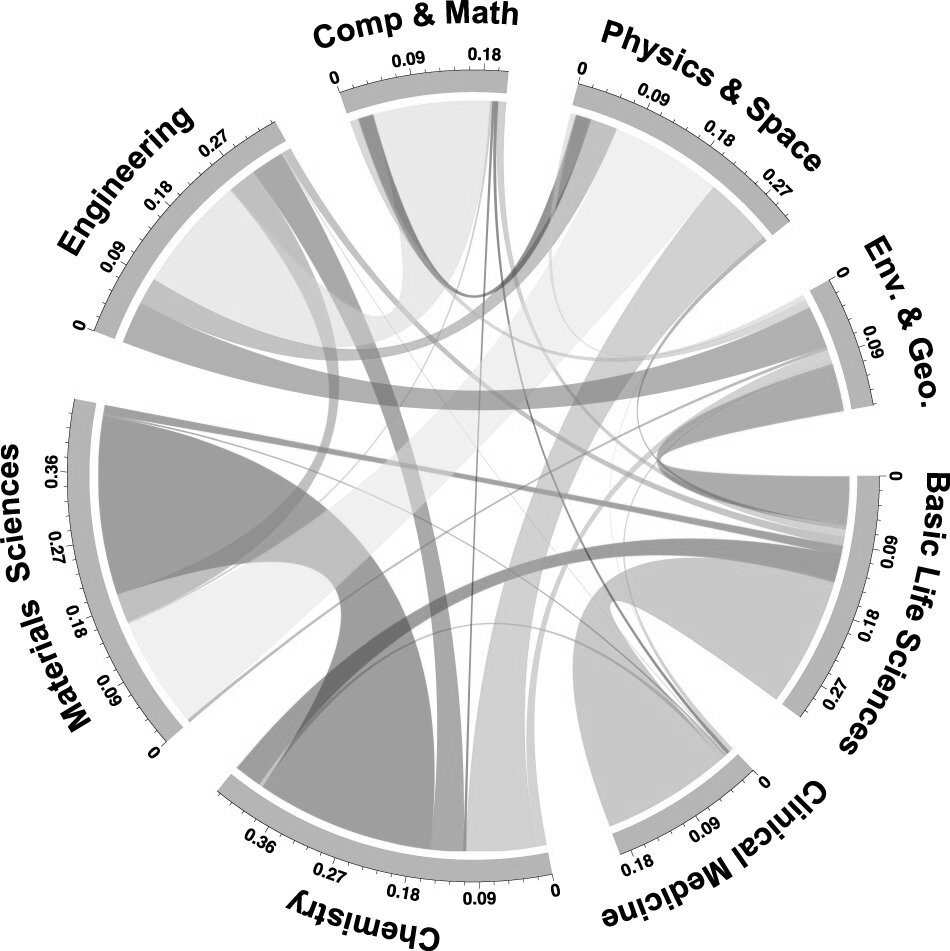
“Interdisciplinarity,” of course, governs only the sciences. What were once called the humanities answer now instead to the architectonics of “intersectionality”: intersected man possesses no self apart from the venn diagram of his various identities, “sex” “race” “gender” “class” “ability” “veteran status.” The resulting selfless-portrait looks not unlike the interdisciplinary dreamcatcher.

Any antagonism between the two is only superficial. The science of interdisciplinarity reveals the empty truth of Complexity; the art of intersectionality reveals how to live within that emptiness. The relationship between them is something like that between philosophy and law, or between speculative and pastoral theology. In theory, theory has the upper hand, but in practice, practice rules. Hence, inspired by passing internet controversies about 2+2=4 being an anti-trans dogwhistle, mathematics professors will spend class time showing that if you redefine two, addition, or equality, it can equal something else. For example, 2+2=1 mod 3.
*
To see why interdisciplinarity bows down to intersectionality we must trace the complexiversity back to the Christian university, with its own productive tension between speculative and practical theology. The ancient world had no universities because ancient law was not philosophical—philosophy mandated only the idea of civic order, not its content. Instead, the ancient world had academies, devoted to the thought of a single philosopher, at which a studious gentleman might retire for a time from civic life. It was the medieval university that first brought together rival intellectual factions under one roof.
Through that act of juxtaposition the university transformed rival factions into rival disciplines. Each discipline sought better to define its respective project by modeling itself on theology, just as the professions—lawyers, physicians, professors—modeled themselves on the priesthood. The project of the university then became the keeping of the peace between the disciplines, a task requiring a symphony of theory and practice. John Henry Newman (theologian, philosopher, educator, historian, poet, novelist) put it as follows, in the lectures collected in The Idea of a University [1852-1858]:
What an empire is in political history, such is a University in the sphere of philosophy and research. It is, as I have said, the high protecting power of all knowledge and science, of fact and principle, of inquiry and discovery, of experiment and speculation; it maps out the territory of the intellect, and sees that the boundaries of each province are religiously respected, and that there is neither encroachment nor surrender on any side.
Of course, as Newman recognizes, a university acts through its members:
Its several professors are like the ministers of various political powers at one court or conference. They represent their respective sciences, and attend to the private interests of those sciences respectively; and, should dispute arise between those sciences, they are the persons to talk over and arrange it, without risk of extravagant pretensions on any side, of angry collision, or of popular commotion.
The disciplines cannot simply ignore one another, but at the same time they must be reluctant to interfere in one another’s affairs. When the empire of intellect succeeds in keeping the peace:
A liberal philosophy becomes the habit of minds thus exercised; a breadth and spaciousness of thought, in which lines, seemingly parallel, may converge at leisure, and principles, recognized as incommensurable, may be safely antagonistic.
A liberal education produces, not virtuous men, exactly, but what Newman calls gentlemen. A gentleman has “a cultivated intellect, a delicate taste, a candid, equitable, dispassionate mind, a noble and courteous bearing in the conduct of life;—these are the connatural qualities of a large knowledge.” Elsewhere, Newman says that “it is almost a definition of a gentleman to say he is one who never inflicts pain.” Importantly, although these qualities of a gentleman are desirable,
They are no guarantee for sanctity or even for conscientiousness, they may attach to the man of the world, to the profligate, to the heartless,—pleasant, alas, and attractive as he shows when decked out in them. Taken by themselves, they do but seem to be what they are not; they look like virtue at a distance, but they are detected by close observers …
Newman’s gentleman appears to possess the fullness of virtue but remains in need of religious instruction. Similarly, the university appears autonomous but in fact must be subordinated to a pastoral mission in order practically to justify its pursuit of knowledge for its own sake. When it abandons its pastoral mission—when it degenerates from the Christian university into the liberal university—it is already on the path to the complexiversity’s emptiness.
*
Almost a century after Newman, Wystan Hugh Auden (poet, playwright, public intellectual) penned a highly Newmanian lament for the state of the modern university, and gave it the highly Newmanian title “Under Which Lyre: A Reactionary Tract for the Times.” Delivered at Harvard University in 1946, this poem takes up Newman’s metaphor of a struggle for intellectual territory:
Let Ares doze, that other war
Is instantly declared once more
’Twixt those who follow
Precocious Hermes all the way
And those who without qualms obey
Pompous Apollo.
“Hermes” and “Apollo” here name what Auden saw as the rival factions of his era:
The sons of Hermes love to play
And only do their best when they
Are told they oughtn’t;
Apollo’s children never shrink
From boring jobs but have to think
Their work important.
The triumph of Apollo, Auden fears, will mean the end of the university:
And when he occupies a college,
Truth is replaced by Useful Knowledge;
He pays particular
Attention to Commercial Thought,
Public Relations, Hygiene, Sport,
In his curricula.
Recognizing the ascendancy of the Apollonians, Auden recommends to the Hermetics something like guerrilla warfare:
Thou shalt not answer questionnaires
Or quizzes upon World-Affairs,
Nor with compliance
Take any test. Thou shalt not sit
With statisticians nor commit
A social science.
It is tempting, reading this poem, to side with the Hermetics—and to be sure, that is where Auden’s sympathies lie. But, a better reading is that both Hermetics and Apollonians are in the grip of an illusion only religious revelation can dissolve. The illusion is that they differ more than they resemble one another. Auden’s 1955 poem “Vespers” narrates the bursting of his own hermetic bubble, in a chance encounter between himself and an Apollonian (though he now renames the dichotomy as between nostalgic Arcadian and revolutionary Utopian). Each instinctively hates the other, but it is this hatred that reveals to them their similarity,
forcing us both, for a fraction of a second, to remember our victim (but for him I could forget the blood, but for me he could forget the innocence)
on whose immolation (call him Abel, Remus, whom you will, it is one Sin Offering) arcadias, utopias, our dear old bag of a democracy, are alike founded:
For without a cement of blood (it must be human, it must be innocent) no secular wall will safely stand.
Which is to say that Auden’s account of the academic rivalry of Hermes and Apollo is Girardian avant la lettre. René Girard (another polymath; his work touched on literature, psychology, anthropology, theology) did not write much about university politics, but his thought is highly relevant to them—not his often-caricatured concept of mimetic desire, but rather his account of how mimetic desire fits into salvation history [e.g., Things Hidden Since the Foundations of the World, 1978]. That account proceeds in four stages:
(a) Mimetic desire and conflict. When Alice desires what Beatrice possesses, it is (often) not really about whatever material good is in dispute, but about Alice’s desire to take Beatrice’s place. Conflict between them is inevitable, irresoluble, and takes the form of Alice coming to resemble Beatrice.
(b) The scapegoat mechanism. As mimetic conflict spreads through a society, rendering everyone increasingly indistinguishable, social order can be restored by singling out a scapegoat, someone to blame for the conflict, and sacrificing them. This sacrifice restores a sense of sacred boundaries, and so social order—and this restoration is taken to confirm the scapegoat’s alleged guilt.
(c) Christian revelation. The gospel, among other things, reveals to us that the victim was no more responsible for the mimetic contagion than anyone else, and thus that the scapegoat mechanism is based on a lie. Once this is understood, the mechanism stops working; people still engage in scapegoating, but it is increasingly ineffective, and traditional hierarchies become increasingly untenable.
(d) Anti-Christianity. Once the scapegoat mechanism can no longer function, an attempt is made to restore social order through a new religion, the worship of victimhood. As Girard puts it in I See Satan Fall Like Lightning [2001], what emerges is a totalitarianism which “takes over and ‘radicalizes’ the [Christian] concern for victims in order to paganize it.” Unfortunately, this aping of Christianity does not bring peace, but sparks a new conflict over whose victimhood will be recognized. When victims are worshipped, the claim to victimhood becomes a kind of aggression.
A Girardian genealogy of the complexiversity would look something like the following. Having excluded religion and revelation, the liberal university at first produced gentlemen, that is, men who, having acquired a large knowledge of science and literature, sought never to inflict pain. This desire to avoid giving pain extended to the drawing of boundaries between the disciplines, in effect a mimetic conflict. But the liberal university slowly lost sight of what made the complacency of such gentlemen desirable. Today it produces not gentlemen, but on the one hand utilitarian scientists who seek to minimize the occurrence of pain by whatever means necessary, and on the other anarchic litterateurs who seek through irresponsible play to demonstrate their sensitivity to the wounds of the world. These seem opposed, but phenomena like D-E-I mathematics show their deeper agreement. Lacking what Newman called “religious respect” for the boundaries between the disciplines, the pain-reducing sciences voluntarily abnegate themselves in order to honor the claims of victimhood studies.
*
Once religious respect is gone, it cannot easily be regained. Where can the university go from here? Well—a professor of my acquaintance once dreamed of founding a college whose curriculum centered on Herman Melville’s Moby-Dick: or, the Whale. The reading list for each course would begin the same way; after all, the book contains within itself not only all of American literature and history, but also philosophy, biology, geography, and more.
The most natural senior project to assign at such a college would be the drafting of an additional chapter of Moby-Dick. Not that there is room for such a chapter, or that the book is in any way incomplete, but (despite the premise of this imagined college) we must acknowledge that many facts about whales have been discovered in recent years that would have been the perfect topic for a new chapter to go somewhere between 55 and 105, had Melville known of them. One student might write about how whales speak to one another, and raise the speculative theory that it was men who taught the whales to speak, by hunting them. Another might write about how the largest whale arteries are broad enough for a man to swim in. Another could compare whale-fall—when a whale’s corpse falls to the ocean floor and sustains for weeks a whole city of fish, crabs, and the like—to the death of God and the flourishing of artistic modernism.
The College of the Whale might be only the first of a whole consortium. I have known other scholars who would dream of doing the same with Plato’s Republic, Dante’s Divina Commedia, or Goethe’s Faust. When enough colleges had come into being, they could launch a graduate program. Its qualifying exams could take as their subject the set of the various colleges’ foundational books, with a student’s dissertation required to be on some book other than these. Apart from the founding members, only persons having received doctorates from the graduate program would be eligible to start new colleges in the consortium. Eventually the consortium would be sufficiently large that the graduate program would be impossible to complete, and no further graduate students could be admitted. Soon thereafter, the set of consortium members would be deemed closed.
So long as colleges in the consortium were limited to sufficiently universal works, there would be no defect in the depth or breadth of any consortium student’s education. A student at the College of the Whale, for example, would know Moby-Dick better than almost any English major at an ordinary college, and would at the same time know more of medicine than your average classics major, more of Greek than your average biology major, and so on. And so long as all the colleges in the consortium shared a city, which is to say, so long as the consortium developed into a university, no consortium student would have a false picture of the centrality of his own college’s chosen perspective. Each student would know that he had read Moby-Dick, or the Divina Commedia, or Faust, not because it is the one book all men must study, but because it is the book chosen for study by the particular community the student joined. Such contingency is unavoidable, since there can be no universal volume any more than there can be a universal language—each attempt is simply another particular volume or particular language clamoring for attention.
What a consortium education would not provide—and this is the point—is a sense for generally accepted disciplinary boundaries. A consortium student would have only a notional understanding of what ordinary academic institutions mean by labels like “English,” “classics,” “biology.” The task of translating ordinary interdepartmental politics into consortium terminology would be difficult, if not necessarily impossible (factor analysis might reveal, for example, that Melville tilts toward politics, Goethe toward science, Dante toward theology). Whenever consortium members reentered the ordinary academic world, they would feel themselves in it, but not of it, and its line-drawing would seem to them as arbitrary as the lines on a map seem to the cosmopolitans ordinary universities churn out. In time they would learn that the lines are less arbitrary than they seem. That experience might make them more willing to take seriously the same proposition about ordinary political boundaries. It is in some such roundabout way, if at all, that we can recover a proper understanding of the empire of the intellect.